
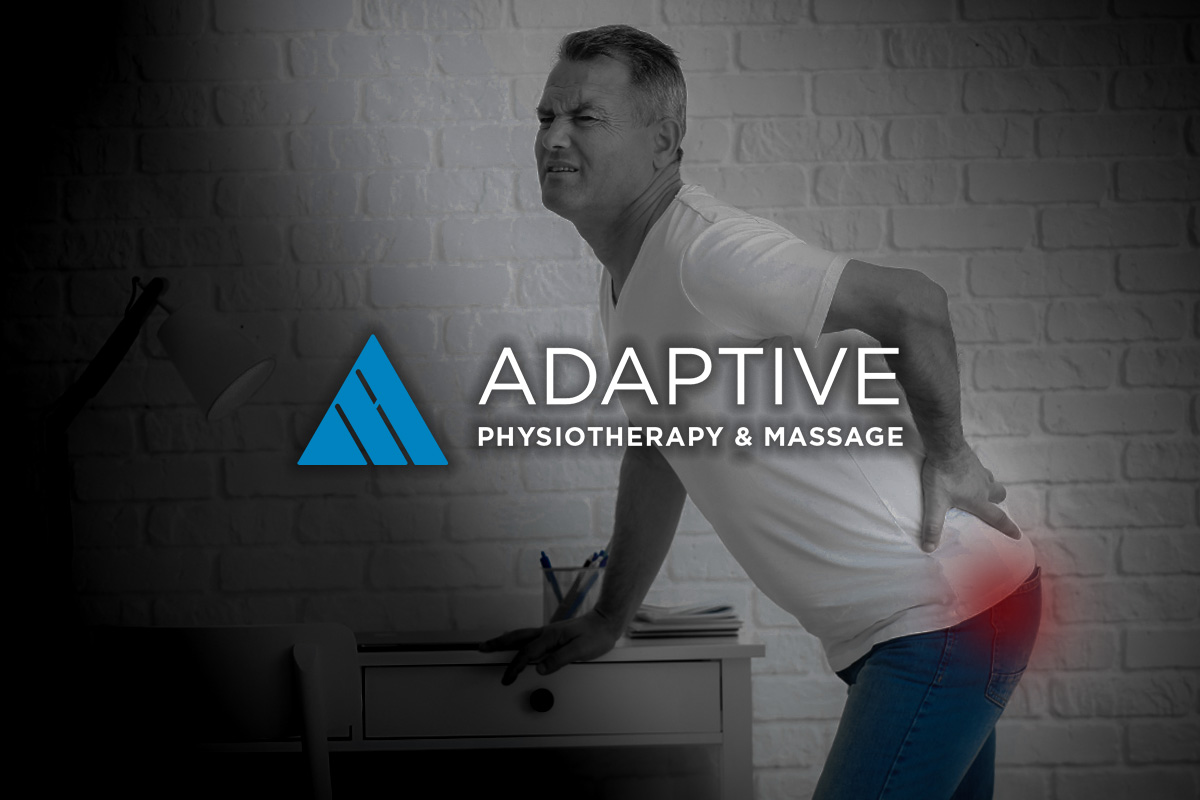
Do you have a deep ache in your buttock that gets worse when you sit for too long?
Maybe it starts during a long drive, becomes uncomfortable after sitting at your desk, or travels down the back of your leg when you try to get moving again.
It can feel a lot like sciatica. One possible explanation is piriformis syndrome, where structures deep in the buttock may irritate the sciatic nerve. But several other conditions can cause similar symptoms, so finding out what is contributing to your pain matters.
At Adaptive Physiotherapy & Massage in Booragoon, we start with your symptoms, your activities and what you want to get back to doing. This guide explains the condition, what an assessment involves and how rehabilitation may help.
What is piriformis syndrome?
The piriformis is a small muscle deep in the buttock, running from the sacrum near the base of the spine to the upper thigh bone. It helps control hip rotation and contributes to hip movement.
The sciatic nerve travels through the deep gluteal region near this muscle. Piriformis syndrome is the term often used when irritation or possible entrapment of the nerve is associated with the piriformis. Clinicians may also use the broader term deep gluteal syndrome when other structures in that area may be involved.
Common symptoms
- Deep, aching pain in one buttock, often aggravated by sitting.
- Pain, tingling or unusual sensations that may travel into the back of the thigh or leg.
- Discomfort with running, walking, climbing stairs or certain hip positions.
- Sensitivity when sitting on the affected side or crossing your legs.
- A sense of tightness or reduced tolerance for hip movement.
Piriformis syndrome vs sciatica: what's the difference?
Piriformis / deep gluteal-related symptoms
Pain is often centred in the buttock and may be aggravated by sitting or activities that load the deep hip muscles. Sciatic nerve irritation outside the spine is one possible mechanism.
Sciatica from the lower back
Sciatic-type leg symptoms can arise when a nerve root is irritated in the lumbar spine, including with some disc-related problems. Symptoms can overlap with deep gluteal pain.
A physiotherapy assessment can help identify likely contributors and determine when further medical investigation is needed. Read more about sciatica and everyday activities or our lower back physiotherapy service in Booragoon.
Can you test for piriformis syndrome at home?
You may notice that sitting with one ankle resting over the opposite knee, or gently moving the hip into a stretch, reproduces your familiar buttock discomfort. However, this is not a reliable self-diagnosis: a painful stretch alone cannot distinguish piriformis syndrome from other hip, nerve or spinal conditions.
Don't force a stretch that produces sharp pain, increasing tingling or other nerve symptoms. If symptoms are persistent or affecting your daily activities, a physiotherapy assessment is a more useful starting point.
What can contribute to symptoms?
- Changes in running, cycling or training load: a sudden increase in activity can aggravate tissues around the hip.
- Long periods of sitting: discomfort may build when the buttock remains under pressure for extended periods.
- Previous injury: hip or lower back symptoms may alter activity tolerance and how you move.
- Hip strength or movement capacity: these may be relevant to the individual, but weakness or a particular posture is not automatically the cause.
- Other diagnoses: lumbar nerve irritation, hip conditions and other deep gluteal problems can present similarly.
How physiotherapy may help
At Adaptive, treatment starts with a conversation and assessment—not an assumption that your piriformis is simply 'too tight'. The plan is based on your symptoms, any neurological findings, current capacity and goals.
Initial pain management and activity modification
Temporarily adjust activities that repeatedly aggravate symptoms without stopping all movement. For some people that means shorter sitting periods, walking breaks, modifying running or cycling volume, or changing how long they remain in certain positions.
Heat or cold may provide short-term comfort if helpful. Gentle hip mobility, including a seated or lying figure-four movement, may be considered only if it does not aggravate radiating symptoms.
Manual therapy and symptom management
Hands-on techniques for the gluteal region, surrounding hip muscles or lower back may help some people manage muscular discomfort. Remedial massage can be relevant for associated muscle tightness where appropriate.
Manual treatment is not assumed to release a trapped nerve or correct a particular pelvic alignment. Nerve mobility exercises may be considered selectively following assessment, especially when nerve symptoms are present.
Exercise rehabilitation and progressive strengthening
Exercises may include glute bridges, side-lying clamshells, seated hip external rotations, single-leg balance and lateral band walks. These are examples—not a fixed prescription for everyone.
Your physiotherapist can adjust exercise range, resistance and frequency as symptoms settle and your tolerance builds. The aim is to strengthen the hips and surrounding muscles while gradually improving confidence in movement.
Return to activity, work and sport
As tolerated, rehabilitation can progress towards walking longer distances, running, gym exercises and work-specific tasks. Athletes may add acceleration and deceleration drills, change-of-direction activities and plyometric loading where appropriate.
Load management, exercise progression and review of symptoms help guide the return to activity. If sporting demands are central to your goals, our sports rehabilitation program may be relevant.
When should you seek further assessment?
Arrange an assessment if buttock or leg pain continues, affects your work or sleep, or returns repeatedly when you resume activity. New or worsening weakness, persistent numbness or unusual symptoms should be assessed by a healthcare professional.
Managing symptoms over the longer term
For many people, the next step is to build up what they can comfortably do rather than search for one perfect stretch or posture. That may include maintaining hip and trunk strength, varying periods of sitting, and returning to activity with manageable increases in load.
Recovery varies. Reassessment is important if symptoms are not responding as expected or if the original diagnosis is uncertain. At Adaptive, we review how you're progressing and change the plan when needed.
The aim is to understand what's contributing to your symptoms, find a sensible starting point and build your capacity from there.
Related reading and services
Book a physiotherapy assessment in Booragoon
If persistent buttock pain or symptoms down your leg are making sitting, walking or training uncomfortable, a physiotherapy assessment can help you understand the possible causes and discuss an appropriate plan.
Adaptive Physiotherapy & Massage · 27 Shields Crescent, Booragoon WA 6154 · Free onsite parking
References
- Hopayian K, Song F, Riera R, Sambandan S. The clinical features of the piriformis syndrome: a systematic review. European Spine Journal. 2010;19:2095–2109. View research.
- Hopayian K, Danielyan A. Four symptoms define the piriformis syndrome: an updated systematic review of its clinical features. View research.
- Lo JK, Robinson LR. Piriformis syndrome. Handbook of Clinical Neurology. 2024;201:203–226. View review.