
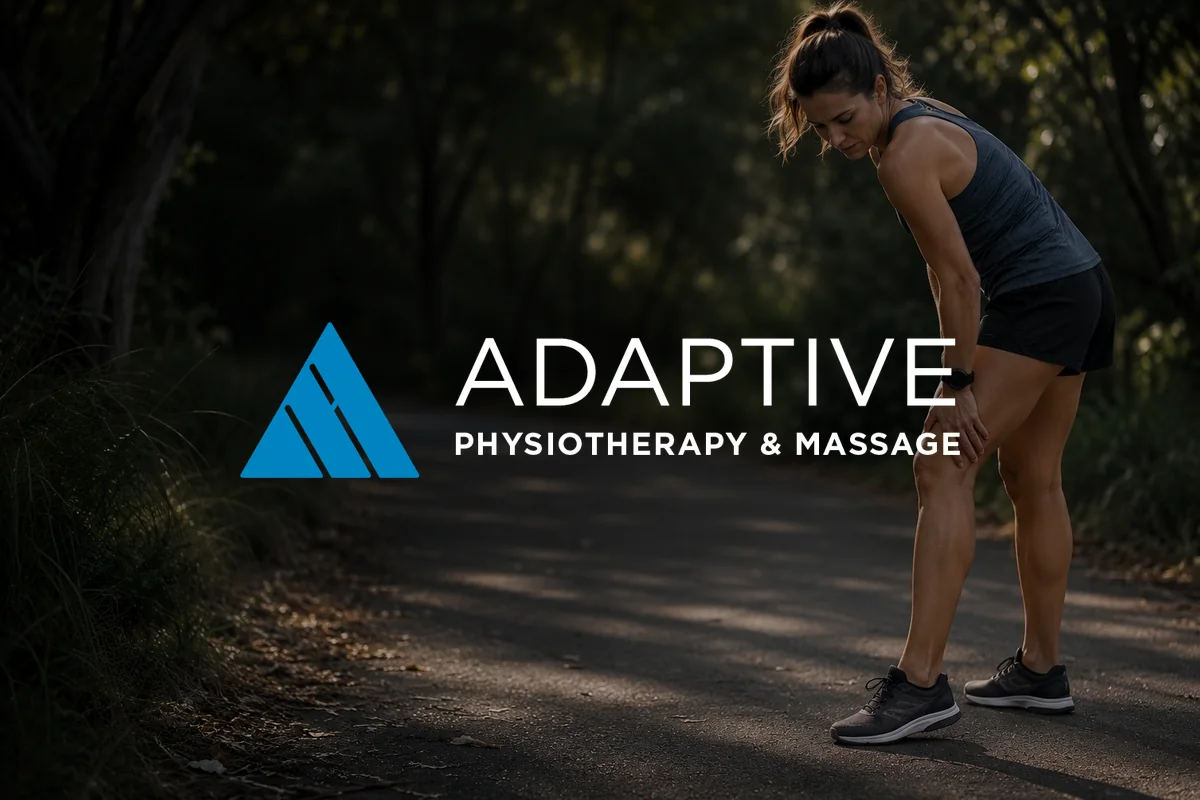
Does the outside of your knee start aching partway through a run?
Maybe the first few kilometres feel fine, then a sharp or burning pain develops on the outside of your knee. Running downhill makes it worse, or you start noticing it during a longer ride on the bike.
That pattern can occur with iliotibial band syndrome (ITBS), sometimes called iliotibial band friction syndrome. It's a common cause of lateral knee pain in runners and cyclists, although other knee problems can produce similar symptoms.
At Adaptive Physiotherapy & Massage in Booragoon, we start by understanding when the pain appears, how much training you're doing and what you want to get back to. A knee physiotherapy assessment can help guide the next steps.
What is iliotibial band friction syndrome?
The iliotibial band (ITB) is a strong band of connective tissue running along the outside of the thigh, from the hip towards the upper shin. It helps transfer forces and contributes to hip and knee function during activities such as walking and running.
ITB syndrome describes pain usually felt near the outside of the knee during repetitive knee bending and straightening. Traditionally, it was explained as the band rubbing over the outer part of the thigh bone. More recent explanations also consider compression and irritation of sensitive tissues beneath the band. The precise mechanism can vary and is not always established by examination alone.
What does ITB syndrome feel like?
Pain outside the knee
A sharp, burning or aching sensation around the outer knee, particularly while running.
Symptoms during repeated activity
Pain may come on after a particular distance, or during longer rides and repeated knee movements.
Hills can aggravate it
Some runners notice increased discomfort on downhill sections or after a change in training terrain.
Local tenderness
The outside of the knee may feel tender. Not all clicking, snapping or lateral knee pain is caused by ITB syndrome.
The location of symptoms provides clues, but it doesn't confirm a diagnosis. A physiotherapist may also consider other causes of lateral knee pain, including meniscal problems, ligament injury and patellofemoral pain.
Why does ITB syndrome develop?
ITB-related pain commonly occurs when the knee is exposed to more repetitive loading than it is currently tolerating. There isn't always one single cause, and it isn't necessarily a result of a 'tight' band or poor running form.
- Training changes: Increased running volume or intensity, new hills, changes in cycling volume or insufficient recovery between demanding sessions.
- Strength and load capacity: Hip and lower-limb strength, endurance and control may be relevant to rehabilitation.
- Running and cycling demands: Cadence, terrain, cycling position and repeated knee loading may influence symptoms for some people.
- Previous injuries or changes in activity: These may affect how much training someone can comfortably tolerate.
At Adaptive, we look at the person and the demands of their activity rather than assuming a particular posture or foot shape is the problem. For people returning to higher-demand exercise, sports physiotherapy can address these factors as part of a broader plan.
How can physiotherapy help ITB syndrome?
Management usually involves adjusting the activities that are aggravating symptoms, developing strength and gradually returning to the loads that matter to you. A completely generic exercise plan isn't always the best starting point.
Initial management and activity modification
We review your training history and identify changes that may make the knee easier to manage while it settles.
- Temporarily reduce or modify painful runs, hills or cycling sessions, rather than automatically stopping all exercise.
- Consider alternative conditioning that you can tolerate.
- Use symptom response during activity and the following day to guide progression.
- Heat or ice may provide temporary comfort if helpful.
Manual therapy and symptom relief
Hands-on techniques may help with associated muscular discomfort or movement restrictions, but are not essential to recovery and don't physically 'lengthen' the IT band.
- Where appropriate, gentle work around the hip, gluteal or thigh muscles.
- Assessment-led hip or knee mobilisation if movement is restricted.
- Remedial massage may be considered for associated muscular discomfort, without replacing progressive rehabilitation.
Avoid repeatedly pressing or aggressively foam rolling directly over the painful outside of the knee. This can aggravate sensitive tissues.
Exercise rehabilitation: strength, control and mobility
Exercise forms an important part of rehabilitation. The specific exercises and difficulty depend on pain, current strength and the demands of running, cycling or everyday movement.
- Early strength: Side-lying hip abduction, bridges, clamshells or other comfortable hip-strengthening exercises.
- Progressive loading: Lateral band walks, step-ups, single-leg squats and other lower-limb resistance exercises.
- Movement control: Single-leg balance and controlled loading where relevant.
- Mobility: Address individual hip, knee or ankle limitations when present. Direct ITB stretching isn't a universal requirement.
As capacity improves, exercise can progress towards the loads and movements needed for your usual activities.
Return to running, cycling and sport
Returning to activity is a progression, not simply a date on the calendar.
- Build from manageable runs or rides towards longer or more demanding sessions.
- Reintroduce hills, speed work or increased cycling loads gradually.
- Review running or cycling mechanics if there is a clear, relevant reason to do so.
- Introduce sport-specific exercises as appropriate, with support from a structured sports rehabilitation program when needed.
The goal is to restore confidence and capacity for your chosen activity, not to eliminate every natural variation in movement.
What about foam rolling, stretching and running shoes?
These are common questions. Stretching and foam rolling may feel helpful for some people, but the IT band is a strong connective tissue structure and aggressive pressure is not required to 'release' it. If stretching makes the outside of the knee worse, it is worth modifying or avoiding that technique.
Footwear changes, orthoses or running-form adjustments can be considered when the assessment suggests a specific benefit. They aren't automatically necessary for everyone with ITB syndrome.
The main point: There is no single exercise, stretch or technique that works for every runner. Rehabilitation is about identifying manageable activity, building capacity and adjusting the plan as your symptoms change.
How long does ITB syndrome take to settle?
Recovery varies. Some people notice progress after modifying training and beginning suitable strengthening; others have symptoms that take longer to improve, particularly if discomfort has been present for months or training demands remain high.
We use your symptom response, functional strength and ability to return to running or cycling to guide progression rather than promising recovery within a set number of weeks.
When should you have your knee assessed?
Consider an assessment if pain on the outside of the knee is repeatedly interrupting your training, getting worse, or affecting walking and everyday activities. Sudden major swelling, inability to bear weight, significant trauma, a hot swollen joint or systemic illness warrants prompt medical attention rather than routine exercise rehabilitation.
A physiotherapy assessment in Booragoon can help distinguish ITB-related pain from other knee conditions and establish an appropriate plan.
Related reading and services
- Runner's Knee: Understanding, Treatment and Rehabilitation — another common cause of running-related knee pain
- Patellar Tendinopathy: Treatment and Rehabilitation — pain commonly felt below the kneecap
- Sports Physiotherapy in Booragoon — assessment and rehabilitation for active people
Book a knee physiotherapy assessment
If pain on the outside of your knee keeps interrupting your running, cycling or everyday activities, we can assess what is contributing and help you build an individualised rehabilitation plan.
Adaptive Physiotherapy & Massage · 27 Shields Crescent, Booragoon WA 6154 · Free onsite parking
References
- Balachandar V, et al. (2024). Effects of conservative treatment strategies for iliotibial band syndrome on pain and function in runners: a systematic review. Frontiers in Sports and Active Living. Read the review.
- Geisler PR. (2021). Current Clinical Concepts: Synthesizing the Available Evidence for Improved Clinical Outcomes in Iliotibial Band Impingement Syndrome. Journal of Athletic Training. Read the article.
- American Academy of Orthopaedic Surgeons. Iliotibial Band (IT Band) Syndrome. Patient information.